
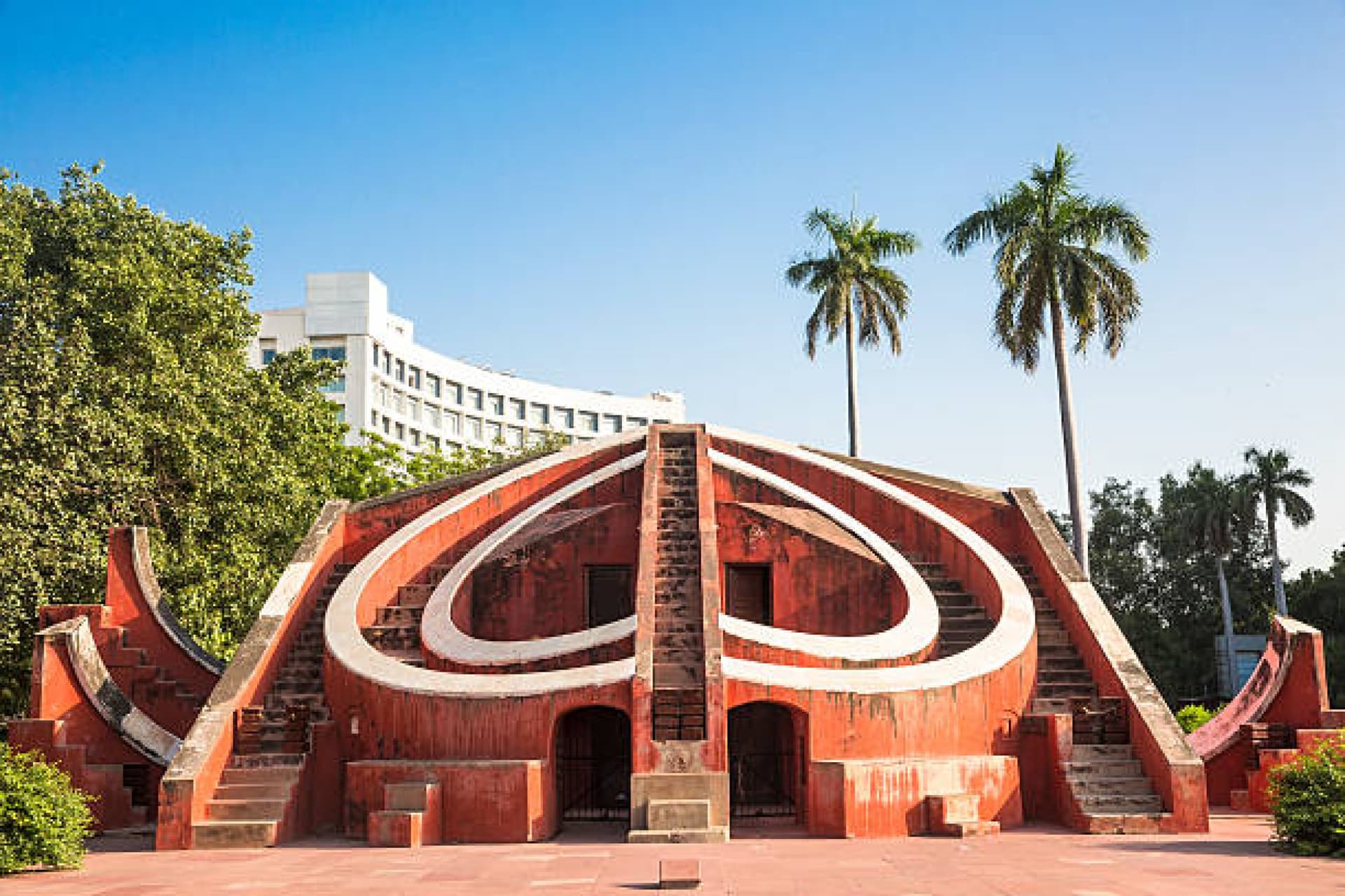
Jantar Mantar is an astronomical observatory located in the heart of New Delhi, India. It is one of several observatories constructed by Maharaja Jai Singh II of Jaipur in the 18th century. The term "Jantar Mantar" translates to "instrument for calculation" or "magical device" in Sanskrit. Here are key features and information about Jantar Mantar in Delhi:
-
Location: Jantar Mantar is situated in Connaught Place, near the Parliament House and Rashtrapati Bhavan, making it a central and easily accessible location.
-
Historical Significance: The observatory was built by Maharaja Jai Singh II of Jaipur between 1724 and 1730. Jai Singh II was a keen astronomer and mathematician, and he established several such observatories across India to study and document celestial movements.
-
Architectural Style: Jantar Mantar is an architectural marvel with its unique and large-sized astronomical instruments. The structures are made of brick, rubble, and plaster, and they exhibit a blend of Islamic and Mughal architectural styles.
-
Astronomical Instruments: The observatory houses several large-scale astronomical instruments, each designed for specific observations. Some notable instruments include the Samrat Yantra (Giant Sundial), Jai Prakash Yantra, Ram Yantra, and Misra Yantra.
-
Samrat Yantra: The Samrat Yantra, or the Giant Sundial, is the most prominent instrument at Jantar Mantar. It measures time with remarkable precision using the position of the sun's shadow. The Samrat Yantra is one of the largest sundials in the world.
-
Jai Prakash Yantra: The Jai Prakash Yantra is a set of two concave hemispherical structures with crosswires, used for measuring the altitude and azimuth of celestial objects.
-
Misra Yantra: The Misra Yantra is a combination of five different instruments, serving various observational purposes. It was designed for determining the shortest and longest days of the year.
-
Ram Yantra: The Ram Yantra consists of two large cylindrical structures used for measuring the altitude of celestial bodies.
-
Chhatri: The Chhatri, or the small domed structure, is an architectural element that enhances the aesthetic appeal of the observatory.
-
Heritage Site: Jantar Mantar in Delhi, along with other Jantar Mantars in India, is recognized as a UNESCO World Heritage Site. The observatories collectively represent an important part of India's scientific and cultural heritage.
-
Public Attraction: Jantar Mantar is a popular tourist attraction and a significant destination for those interested in astronomy, history, and architecture. Visitors can explore the various instruments and learn about the scientific achievements of Maharaja Jai Singh II.
-
Educational Value: The observatory serves as an educational site where visitors can gain insights into ancient Indian astronomy and the advancements made by Maharaja Jai Singh II.
Jantar Mantar is not only a historical monument but also a testament to India's rich heritage in the field of astronomy. It continues to be a site of interest and exploration for both tourists and locals interested in the scientific achievements of the past.