
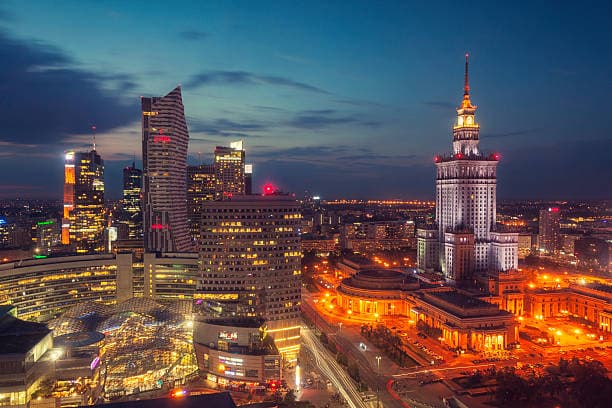
The Palace of Culture and Science (Pałac Kultury i Nauki, abbreviated as PKiN) is a significant and iconic building located in Warsaw, Poland. Here are key features and information about the Palace of Culture and Science:
-
Construction: The Palace of Culture and Science was built between 1952 and 1955. It was a gift from the Soviet Union to the people of Poland, and its construction was directed by Soviet architect Lev Rudnev.
-
Architectural Style: The architecture of the Palace is characterized by the Socialist Realist style, which was prominent in the Soviet Union during the mid-20th century. The building is massive, with a combination of classical and modernist elements.
-
Height: Standing at 231 meters (757 feet) tall, the Palace of Culture and Science is the tallest building in Poland and was the tallest in Europe at the time of its completion. It remains one of the tallest buildings in the country.
-
Purpose: Originally intended to be a symbol of the friendship between Poland and the Soviet Union, the Palace served various functions. It housed cultural and scientific institutions, including theaters, museums, a cinema, and an observation deck.
-
Multifunctional Complex: The Palace of Culture and Science is a multifunctional complex, featuring a range of facilities and services. It includes the Congress Hall, numerous conference rooms, and exhibition spaces. The building also houses offices, educational institutions, and a swimming pool.
-
Cultural Institutions: The Palace hosts several cultural institutions, including the Museum of Technology, the Museum of Evolution, and the Museum of Agriculture.
-
Cinemas and Theaters: Inside the Palace, there are several cinemas and theaters, offering a variety of cultural and entertainment events, including film screenings, plays, and concerts.
-
Observation Deck: One of the most popular attractions of the Palace is the observation deck, located on the 30th floor. Visitors can enjoy panoramic views of Warsaw from this vantage point.
-
Controversy: The construction of the Palace of Culture and Science was a subject of controversy, as it was seen by some as a symbol of Soviet dominance over Poland during the communist era. Its imposing presence in the cityscape has sparked debates about its historical significance and architectural value.
-
Adaptations: In recent years, efforts have been made to adapt some of the spaces within the Palace for contemporary uses. For example, some offices and cultural institutions have been modernized, reflecting changes in the city's cultural and economic landscape.
-
Symbol of Warsaw: Despite its controversial history, the Palace of Culture and Science has become a recognizable symbol of Warsaw. It is often featured in postcards, photographs, and depictions of the city's skyline.
While the Palace of Culture and Science has a complex history and mixed perceptions, it remains a notable landmark in Warsaw and an integral part of the city's architectural and cultural identity.